Can You Steal In Banana Ball?
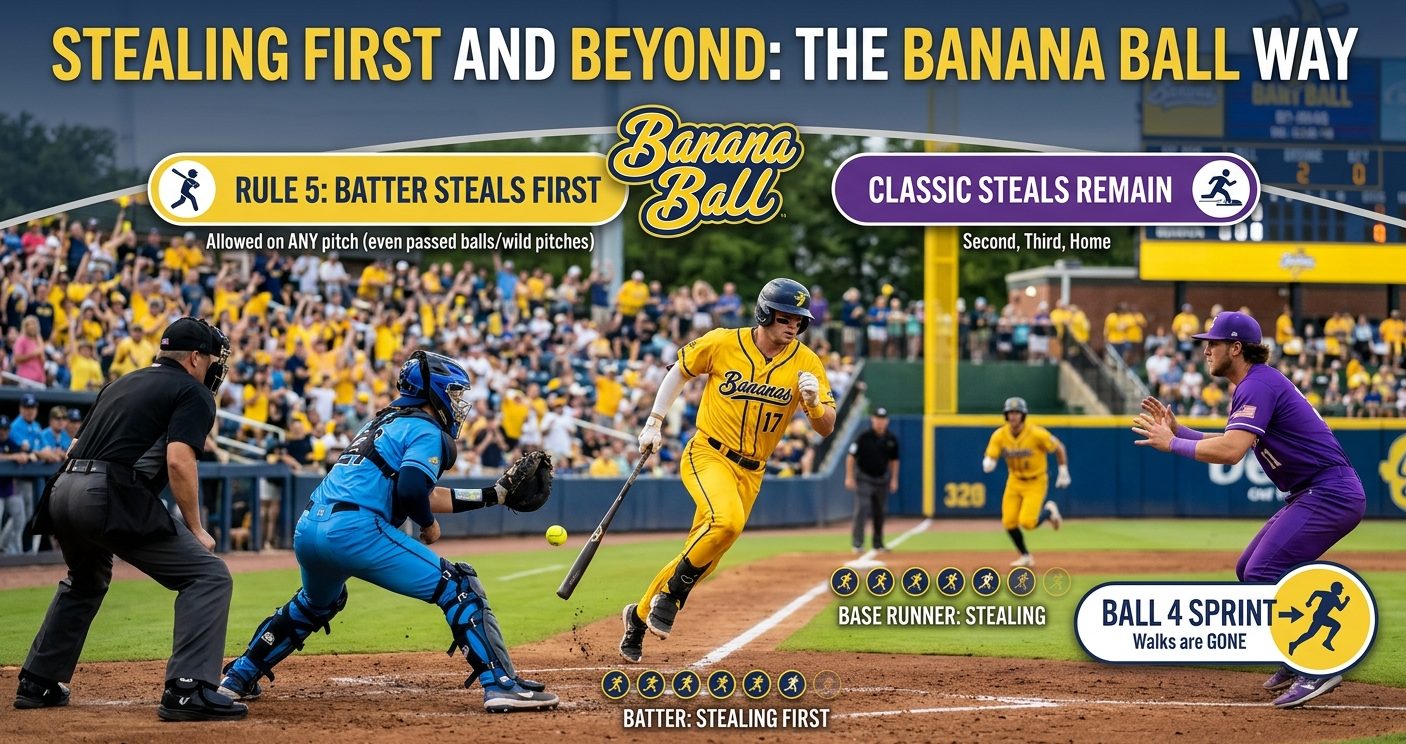
Yes, you can steal in Banana Ball, and the rules go a step past regular baseball. Rule 5 lets the batter break for first base on any pitch of an at-bat.
Runners already on base keep the usual steals of second, third and home. Rule 6 also wipes out walks, so ball four starts a sprint. Both rules sit on the official Banana Ball rules page, last updated October 20, 2026.
Can You Steal in Banana Ball? Rule 5 Lets Batters Take First
Rule 5 is one of the 11 rules in the Banana Ball rulebook, and its title says it in four words: batters can steal first.
The hitter may try for first on any pitch of the at-bat. The count does not matter. A batter with zero strikes has the same right as one with two.
The window opens with the first pitch. It closes when the plate appearance ends.
Wild Pitch or Passed Ball: When the Batter Breaks
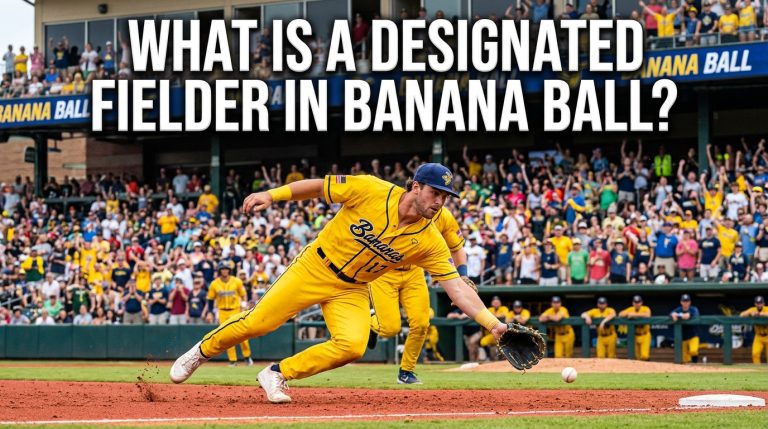
The current rule names two openings: a passed ball and a wild pitch. Each one buys the hitter a few seconds while the catcher chases the ball.
| Pitch situation | What happens | Can the batter run? |
|---|---|---|
| Wild pitch | The throw sails out of the catcher’s reach | Yes |
| Passed ball | A catchable pitch gets dropped or slips by | Yes |
| Clean catch | The catcher holds the ball | Allowed by the “any pitch” wording, but seldom worth the risk |
Can a Batter Run When the Catcher Holds the Pitch?
An earlier version of Rule 5 on the official site said the hitter could go any time they chose. The current text names passed balls and wild pitches and nothing else.
Either way, a clean catch leaves the catcher a short throw to first. That makes it a poor bet for the hitter.
Banana Ball’s Steal of First vs. MLB’s Dropped Third Strike
Major League Baseball allows one narrow version of this play. Under MLB’s Official Baseball Rules, a batter may run on an uncaught third strike if first base is open or there are two outs.
Banana Ball opens that door on every pitch and every count. It also drops the walk, which MLB still awards after four balls.
| Situation | Banana Ball | MLB |
|---|---|---|
| Uncaught pitch, strike one or two | Batter may run for first | Batter stays at the plate |
| Uncaught third strike | Batter may run for first | Batter may run if first is open or with two outs |
| Ball four | Sprint; batter may keep going | Batter awarded first base |
| Bunt attempt | Hitter ejected | Allowed |
Soft contact is off the table too. Under Rule 4, a bunt gets the hitter ejected on the spot.
So fast hitters have one less tool. The steal of first gives that speed a different outlet.
Can You Steal Second, Third and Home in Banana Ball?
Yes. Runners already on base keep every standard option. They can steal second, take third or race home, just as in a regular game.
Nothing about these classic steals changes. The runner still races the catcher’s throw to the next bag.
The change is in volume. A Banana Ball defense tracks two threats at once: the runner on base and the hitter in the box. All six BBCL clubs play under the same rules, from the Savannah Bananas to the Indianapolis Clowns.
| Type of steal | Who runs | Target |
|---|---|---|
| Steal of first | Batter at the plate | First base |
| Classic steal | Runner already on base | Second, third or home |
No Walks in Banana Ball: Ball Four Starts a Sprint
Rule 6 removes the walk. When the umpire calls ball four, the hitter takes off and may advance as many bases as they want.
The defense has its own job. Every defensive player on the field must touch the yellow Banana Ball baseball before it becomes live. The rule exempts the pitcher and catcher, which leaves seven fielders.
Each throw costs time. A clean relay holds the runner close, while a slow one can hand the offense extra bases. This walkthrough of how a Banana Ball game unfolds shows where the sprint fits in a full game.
Ball-Four Sprints in the Showdown Tiebreaker
The sprint works differently in a tie. In Showdown Rounds 1 and 2, the official rules place a runner at second base after ball four.
A second ball four in the same at-bat moves that runner to third. The batter then keeps hitting with a reset count, if the manager chooses.
What Banana Ball Catchers and Pitchers Watch on Every Pitch
Since a hitter can run on any pitch that gets away, catchers have little room for error. One dropped ball can send the batter up the line.
Pitchers carry the same load. A wild pitch opens the door, and Rule 7 bans mound visits from coaches, catchers and other players. No one walks out to reset them.
The rule fits the format’s push for pace. Games run on a two-hour clock, and a passed ball turns into a footrace instead of a pause.
The first baseman has to stay alert on every pitch, even with the bases empty. Hitters need to track the ball on pitches they take, too.
FAQs
Can you walk in Banana Ball?
No. Rule 6 bans walks. Ball four starts a sprint, and the hitter may take as many bases as they want before every fielder except the pitcher and catcher touches the ball.
Can a batter steal first base on any pitch in Banana Ball?
Yes. Rule 5 lets the hitter try for first on any pitch of an at-bat, at any count. The official rule names wild pitches and passed balls as the openings.
How many fielders must touch the ball after ball four in Banana Ball?
Seven. Every defensive player on the field must handle the ball before it becomes live, but the rule exempts the pitcher and catcher.
Can you bunt in Banana Ball?
No. Rule 4 bans bunting, and a hitter who bunts is ejected from the game. That leaves the steal of first and the ball-four sprint as the format’s speed plays.
What should you check before trusting a Reddit answer on stealing first?
Check the rule’s date. An earlier Rule 5 let hitters run any time they chose, while the current text names wild pitches and passed balls. Compare any Reddit claim with the official rules page.