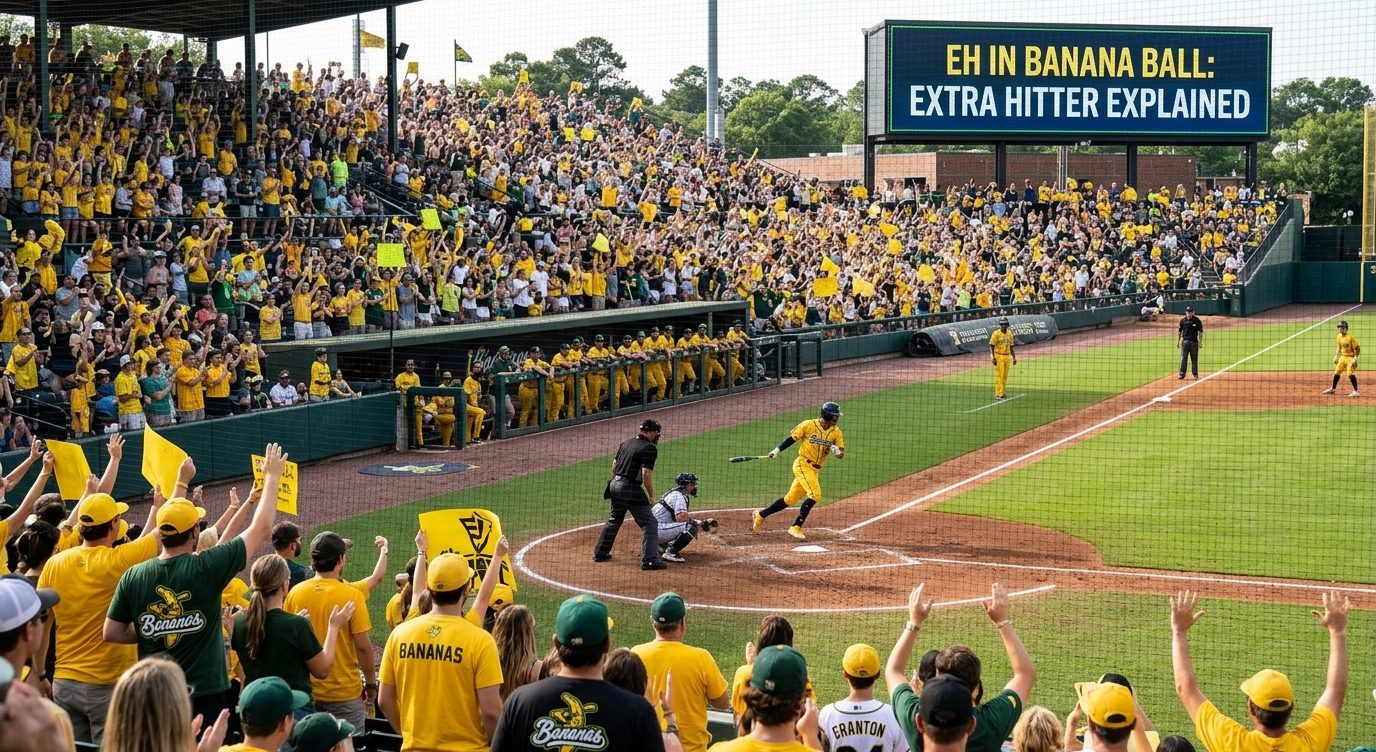
What Is EH in Banana Ball?
EH in Banana Ball stands for Extra Hitter. It is one of two special hitting roles in a Banana Ball lineup, next to the designated hitter (DH), and it is the reason each order runs ten deep instead of nine.
The EH can take the field at any point in a game. Later, that player can slide back into a hitting-only role, and no penalty follows. Here is how that works on a real lineup card.
What EH Means in Banana Ball and Where It Sits in the 10-Spot Lineup
The official Banana Ball rules place the DH and the EH in two of the ten lineup spots. The league’s help desk repeats that setup in an article last updated on July 27, 2026.
The other eight spots go to the fielders. The pitcher stays out of the order unless the DH moves to defense, a cost covered further down.
The ten-hitter order is one of several lineup quirks laid out in the full Banana Ball rulebook in plain English. Every full turn through the order now takes ten trips to the plate, not nine.
How the Banana Ball Extra Hitter Moves Between Defense and the Plate
Banana Ball’s rules state that, unlike the DH, the extra hitter can enter on defense at any point in the game. The rule sets no inning limit.
The First-Base Swap From the Official Rulebook
The league gives one worked example. A player starts as the EH, then moves to first base for an inning.
While that happens, the original first baseman takes over the EH spot. Once the inning ends, the two can switch back if the coach wants.
Why the EH Swap Costs Nothing
The help desk says the EH can return to the EH role with no penalty. The pitcher does not get pulled into the batting order, which is the price a DH move carries.
That gives a coach a simple way to rest a fielder. A starter can sit out an inning in the EH role and still keep a turn at the plate.
EH vs DH in Banana Ball: Who Pays the Price on Defense?
Both roles can play the field. The gap shows up in what happens to the batting order afterward.
When the DH enters on defense, the DH keeps hitting from the same spot. The pitcher must then bat in place of the fielder who came out, according to the Banana Ball help desk.
| Rule point | DH | EH |
|---|---|---|
| Can play defense | Yes | Yes, at any point |
| Batting after the move | Same lineup spot | Can return to the EH role |
| Pitcher’s turn at bat | Pitcher bats for the replaced fielder | No change |
| Penalty | Yes | None |
Standard amateur baseball is harsher. Under the common DH rule described by Umpire Bible, a DH who plays defense ends the DH role for the rest of the game.
Banana Ball keeps its DH alive and charges a smaller fee instead. These lineup rules feed into the point-per-inning scoring system, where each inning is scored as its own contest.
Where the Extra Hitter Rule Existed Before Banana Ball
Banana Ball did not invent the EH. Umpire Bible traces the role to amateur and youth baseball, where the aim was to get more players into games.
The EH is not part of the Official Baseball Rules and is not used in MLB play. The American League adopted the DH in 1973, but no tenth batter followed.
According to Umpire Bible, an amateur lineup with a DH lists ten players and nine hitters. Add an EH, and it lists eleven players with ten hitters.
Banana Ball’s order matches that ten-hitter count. Keep it in mind when reading Banana Ball box scores and game stats.
How Banana Ball’s EH Differs From Youth League Versions
Amateur EH rules vary by league. Umpire Bible notes the EH must be named on the starting lineup, and its slot in the order cannot change during the game.
Banana Ball’s published rules do not spell out those points. They focus on movement: the EH can play defense at any point and come back to the EH role.
Some youth Banana Ball tournaments run on NFHS rules with a supplement sheet on top. Anyone starting their own Banana Ball team should check how that local sheet treats the EH.
Can a Banana Ball EH Be the Golden Batter or Designated Runner?
Rule 11, the Golden Batter rule, lets a team send any hitter in the lineup to bat in any spot, once per game. The EH holds a lineup spot, so the EH fits that wording.
The designated runner is a separate player each of the six BBCL clubs may name before a game. That runner can enter once per turn through the order and becomes eligible again when the lineup flips back to the leadoff batter.
The designated fielder can join in any inning at any position. If that player takes an at-bat or replaces a starter, the role ends for the rest of the game.
Of the four flexible roles, the EH is the one with no listed cost. Before your next game, a look at current BBCL rosters can hint at who might fill that tenth spot.
FAQs
What does EH stand for in Banana Ball?
EH stands for Extra Hitter. It is one of two special hitting spots, alongside the DH, in a ten-spot Banana Ball lineup. The EH can play defense at any point and return to hitting duty without a penalty.
How many hitters are in a Banana Ball lineup?
Ten. Banana Ball lineups hold ten spots, compared with nine in standard baseball. The designated hitter and the extra hitter take two of them, and the other eight belong to the fielders.
What is the difference between a DH and an EH in Banana Ball?
Both can play defense. When the DH enters the field, the pitcher must bat for the replaced fielder. The EH can move to the field and back to the EH role with no penalty.
Is the extra hitter used in MLB?
No. The EH is not part of the Official Baseball Rules used in MLB. It comes from amateur and youth baseball, and Banana Ball runs its own version with free movement between the field and the lineup.
Is Reddit reliable for checking the Banana Ball EH rule?
Reddit threads can help with fan views, but Banana Ball rules change between seasons. For the current EH wording, check the official help desk article, updated July 27, 2026, or the rules page on bananaball.com.